

 ПН - ПТ 8:00-18:00


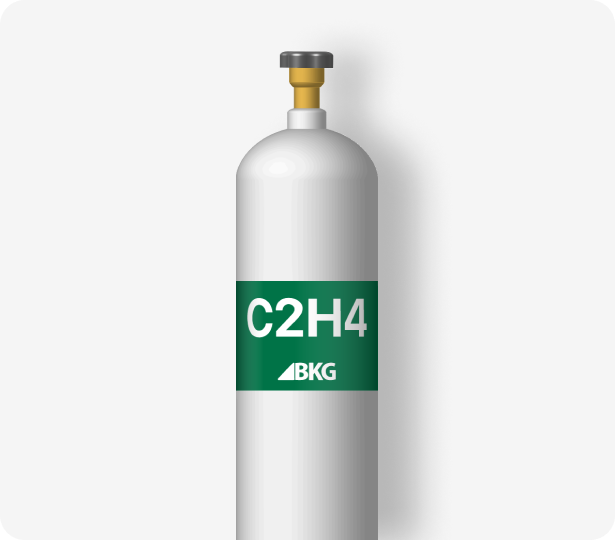
Ethylene (C2H4)
-
Basic info:
-
English name
Ethylene
-
CAS
74-85-1
-
Hazard info
1962; 1038
-
Transport
"ADR Class 2, 2F"
Subclass 2.1
Properties:
-
Molar mass
28.054
-
Gas density at 15°С/1,013 bar
1.194
-
Boiling point at 1,013 bar
-103.68
Options
- single-piece
2 l5 l10 l — 150 bar
50 l (200) — 200 bar
- Cylinder 1 l, 2 l, 5 l, 12 l, 20 l, 50 l, 59.5 l, 112 l. (DIN 1) DIN 1 (W21,6x1/14'' LH)
Specs
| Ethylene 3.0 | Ethylene 3.5 | ||
|---|---|---|---|
| Composition | |||
| C2H4 | % | ≥99,9 | ≥99,95 |
| Admixture | |||
| O2 | ppmv | <10 | <10 |
| N2 | ppmv | <100 | <40 |
| H2O | ppmv | <5 | <5 |
| C2H6 | ppmv | <500 | |
| CnHm | ppmv | <300 | <500 |
| C2H2 | % | <2 | |
| CO2 | ppmv | <5 | <10 |
| CO | ppmv | <10 | |
Ethylene is a colorless gas with a sweetish taste and odor, which is of great value for all fields of industry.
Organic compound obtained by pyrolysis of petroleum distillates or saturated hydrocarbons (ethane, propane, butane), it is also a phytohormone for almost all plants.
- colorless flammable gas
- lighter than air with a faintly sweet odor
- capable of explosive decomposition under increased pressure
- capable of explosive decomposition at high temperatures or open flame in the presence of oxygen
The gas plays a key role in the organic synthesis of several substances for industrial, agricultural, electrical engineering, construction, food, and other sectors:
- Polyethylene;
- Acetic acid;
- Vinyl acetate;
- Ethanol;
- Vinyl chloride/dichloroethane;
- Ethylene oxide;
- Ethylene glycol, etc.
 Chemical industry
 Cylinders must be transported in a horizontal position with spacers between the cylinders or in a vertical position with protection against possible falling. Transportation in packaged form in special containers is allowed.
Joint transportation with oxygen cylinders is not allowed.
Movement/transportation must comply with the codes of the relevant type of transport, federal laws, other regulatory acts, and the legislation of the country where the movement/transportation/reloading occurs.
Can be transported by
- train
- truck
- ship