

 ПН - ПТ 8:00-18:00


Isobutane (i-C4H10)
-
Basic info:
-
English name
Isobutane
-
CAS
75-28-5
-
Hazard info
1969
-
Transport
ADR Class 2.1
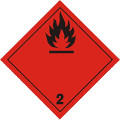
"ADR Class 2, 2F"
Properties:
-
Molar mass
64.0638
-
Gas density at 15°С/1,013 bar
2.537
-
Boiling point at 1,013 bar
-11.72
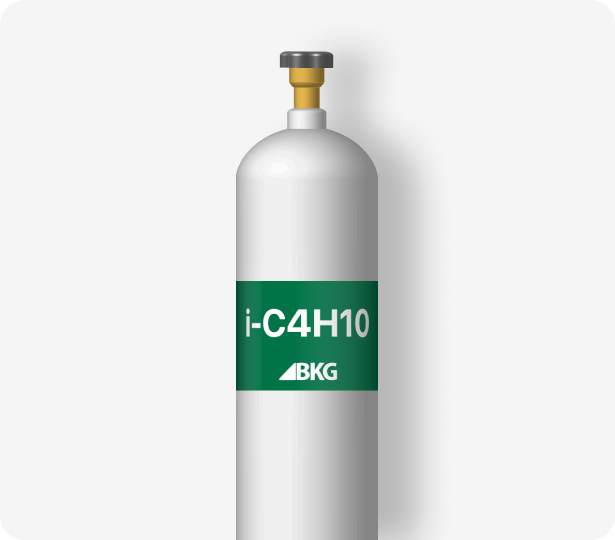
Options
- single-piece
2 l — 1 кг
5 l — 3 кг
12 l — 6 кг
50 l — 23 кг
112 l — 55 кг
- Cylinder 1 l, 2 l, 5 l, 12 l, 20 l, 50 l, 59.5 l, 112 l. (DIN 1) DIN 1 (W21,6x1/14'' LH)
Brass single-stage regulator for pure gases
Specs
| Isobutane 2.5 | Isobutane 3.0 | Isobutane 3.5 | ||
|---|---|---|---|---|
| Composition | ||||
| i-C4H10 | % | 99,5 | ≥99,9 | ≥99,95 |
| Admixture | ||||
| C3H8 | ppmv | <3000 | <500 | <250 |
| n-C4H10 | ppmv | <2000 | <500 | <400 |
| ост.C4 | ppmv | <100 | <100 | <50 |
| Sulfur | ppmv | <1 | <1 | <1 |
| H2O | ppmv | <12 | <10 | <10 |
| O2+H2 | ppmv | <30 | <15 | <15 |
| N2 | ppmv | <100 | <50 | <50 |
| CO+CO2 | ppmv | <20 | <20 | <20 |
| 1,3 Butadiene | ppmv | <1 | <1 | <1 |
- Colorless gas
- Slightly sweet odor
- Heavier than air
- Extremely flammable
- Soluble in organic solvents
- Reacts with strong oxidizers
- Found in gas condensate and petroleum gases.
- The primary use of pure isobutane in production is as a raw material for the synthesis of isobutylene and isoprene. These substances, in turn, are monomers for the production of synthetic rubbers;
- Isobutane gas is often used as a refrigerant, most intensively in household refrigerators. It is environmentally friendly and does not damage the ozone layer. The use of isobutane as refrigerant R600a ensures low energy consumption, but safety measures must be observed;
- It is used in petrochemistry as a component in the pyrolysis process to ultimately obtain ethylene and propylene;
- Pure isobutane is also used as a raw material for alkylation (a process of producing high-octane gasoline components);
- Isobutane can be a component of fuel for internal combustion engines due to its high octane rating;
 Analytics
  Car industry
  Food industry
  Nanotechnologies
  Metallurgy
 Hazard class 4 (flammable mixture). Liquefied isobutane gas is transported by any type of transport in railroad tank cars, as well as in cylinders, containers, and other vessels designed for pressure up to 2 MPa. It is important to follow all safety measures during transportation because isobutane is extremely flammable, and a mixture of the gas with air can explode. Isobutane is non-toxic to humans and the environment, but inhalation can cause shortness of breath and suffocation, and skin contact can cause frostbite.
It is stored in warehouses providing protection from sunlight and cool temperatures.
Can be transported by
- train
- truck
- ship