

 ПН - ПТ 8:00-18:00


Nitrogen oxide (NO)
-
Basic info:
-
English name
Nitrogen oxide
-
CAS
10024-97-2
-
Hazard info
1070
-
Transport
"ADR Class 2, 1 TOC"
Properties:
-
Molar mass
30.008
-
Gas density at 15°С/1,013 bar
1.3402
-
Boiling point at 1,013 bar
151.7
Options
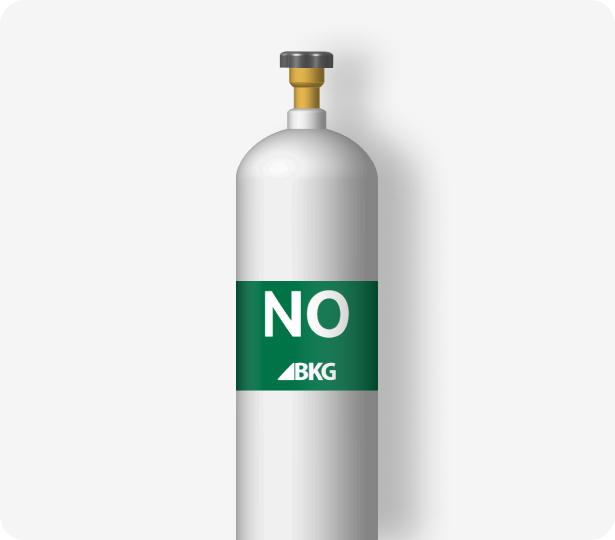
- single-piece
5 l10 l — 150 bar
- Cylinders 2 l, 5 l, 10 l (DIN 6 (W21.6x1/14'')) DIN 6 (W21.6x1/14'')
Stainless steel single-stage for
clean gases with stainless steel
membrane
Specs
| Nitrogen oxide 2.5 | Nitrogen oxide 3.0 | ||
|---|---|---|---|
| Composition | |||
| NO | % | ≥99,5 | ≥99,9 |
Nitric monoxide (nitric oxide, nitric oxide (II)). NO has a triple bond within a linear molecular structure. Therefore, it is a reactive, paramagnetic gas without color. Under normal conditions, it is heavier than air, easily mixes with alcohols, ether, sulfuric acid, and dissolves well in polar solvents.
At 0˚C and pressure of 20 atm., nitric oxide turns into a liquid aggregate state, acquiring a blue shade. In any form, toxicity and low fire hazard remain. However, the gas is capable of supporting the combustion of cyclopropane and oils.
Due to its ability to oxidize almost instantly, pure NO can only be obtained under industrial conditions. The ammonium nitrate decomposition reactions, the interaction of nitrous oxide with potassium permanganate, the reduction of dilute nitric acid with copper, etc. are used.
Some gas is produced during a thunderstorm when lightning strikes. Other sources – exhaust gases, chemical reactions – help synthesize nitrogen oxides with an oxidation state of up to +5 (nitrous oxide, dioxide, trioxide, nitrogen pentoxide). Each of the compounds is poisonous, it has an individual set of physical and chemical properties and high value for various industrial fields.
- Colorless toxic gas
- Turns brown when interacting with oxygen
- Poorly soluble in water
- Hard to liquefy
- Blue color in liquid form
Due to its effect on the nervous system, nitrous oxide is highly sought after in medicine for anesthesia. It is used in surgery, dentistry, obstetrics. This gas is also considered a bioproduct as it is found in almost all types of organisms.
The substance also finds wide application in other industrial sectors:
- Improving the performance of internal combustion engines in vehicles by enriching them with oxygen;
- Packaging various products in a specialized gas environment;
- Manufacturing aerosols;
- Fuel oxidation in mixtures with ethanol, acetylene;
- Preserving the flavor quality of food products during long-term storage, etc.
 Chemical industry
  Car industry
 Transportation of nitrous oxide is carried out considering its toxicity, corrosive effects, and its ability to detonate and oxidize. Transportation of cylinders should be done in a horizontal position with spacers between cylinders or in a vertical position with protection against possible falling.
Transportation in packaged form in special containers is allowed.
Joint transportation with cylinders of oxygen is not allowed.
Transportation/handling must comply with the codes of the respective type of transport, federal laws, other regulatory acts, and the legislation of the country where the transportation/handling/reloading occurs.
Can be transported by
- train
- truck
- ship