

 ПН - ПТ 8:00-18:00


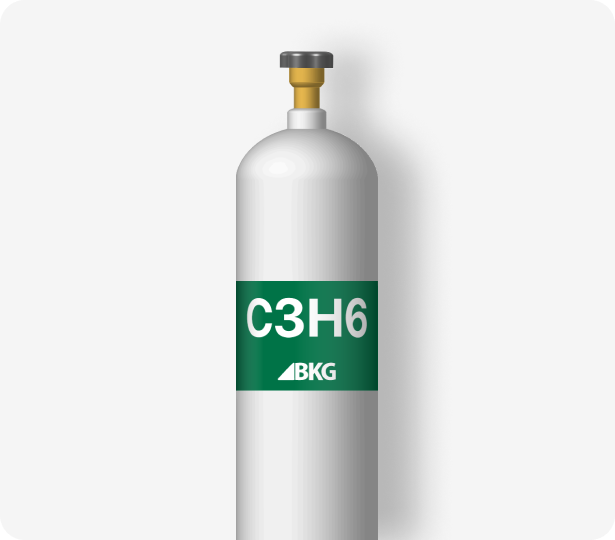
Propylene (C3H6)
-
Basic info:
-
English name
Propylene
-
CAS
7727-37-9
-
Hazard info
1066 (compressed) 1977 (cryogenic)
-
Transport
"ADR Class 2, 2F"
Subclass 2.1
Properties:
-
Molar mass
42.081
-
Gas density at 15°С/1,013 bar
1.809
-
Boiling point at 1,013 bar
-47.69
Options
- single-piece
2 l5 l12 l — 150 bar
50 l (200) — 200 bar
- Cylinder 1 l, 2 l, 5 l, 12 l, 20 l, 50 l, 59.5 l, 112 l. (DIN 1) DIN 1 (W21,6x1/14'' LH)
Stainless steel single-stage for
clean gases with stainless
membrane
Specs
| Propylene 2.5 | Propylene 3.0 | Propylene 3.5 | ||
|---|---|---|---|---|
| Composition | ||||
| C3H6 | % | ≥99,5 | ≥99,9 | ≥99,95 |
| Admixture | ||||
| C3H8 | ppmv | <4500 | <700 | <500 |
| CH4 | ppmv | <200 | <100 | <50 |
| Total sat+unsat C2 | ppmv | <600 | <200 | <100 |
| Sulfur | ppmv | <1 | <1 | <1 |
| H2O | ppmv | <15 | <5 | <4 |
| O2+H2 | ppmv | <30 | <20 | <20 |
| N2 | ppmv | <50 | <50 | <40 |
| CO+CO2 | ppmv | <20 | <10 | <10 |
| 1,3 Butadiene | ppmv | <1 | <1 | <1 |
| Total sat+unsat C4+C5 | ppmv | <1000 | <100 | <50 |
Propylene (propene) is an organic gas, unsaturated hydrocarbon. It belongs to the alkenes group. The chemical formula of the substance is C3H6.
Propylene gas is produced both in laboratory and in the industrial conditions. Propylene is produced by thermal decomposition of hydrocarbons and oil refining at high temperatures. This gas is also released during the following chemical reactions: dehydrogenation of propane with a catalyst, dehydration of isopropanol, halogen elimination from propane dihalogen derivatives, during the partial hydrogenation reaction of propine, as well as dehydrohalogenation of halogenated alkanes under the influence of alkali solutions in alcohol.
- Gas without color or taste. With a slight odor
- flammable
- explosive
- heavier than air
- slightly soluble in water, dissolves in hydrocarbons
- autoignition temperature - 410°C
- in terms of its effect on humans
- propylene is classified as a low-risk compound
- In various industries, particularly as a by-product gas for creating oxygen-free conditions in semiconductor fabrication;
- In cylinders with flammable substances to create an inert atmosphere;
- As a mobile phase in analytical processes (chromatography, mass spectrometry, and others);
- Propylene is used as a component for calibrating the zero of a device (zero gas);
- In the synthesis of ammonia using the Haber-Bosch method;
- As a component of calibration gas mixtures.
 Oil and Gas
  Chemical industry
  Electronics
  Power industry
 Propylene gas, according to the classification of ADR, is classified as Class 2 hazardous. Cylinders with propylene are transported by rail and road in accordance with the rules for the transport of hazardous goods. Propylene does not react with water under normal conditions and does not form toxic compounds in the air.
Propylene should be stored in accordance with the requirements of GOST 1510 and the rules for the design and safe operation of pressure vessels. Storage facilities must ensure fire resistance and a cool temperature.
Can be transported by
- train
- truck
- ship